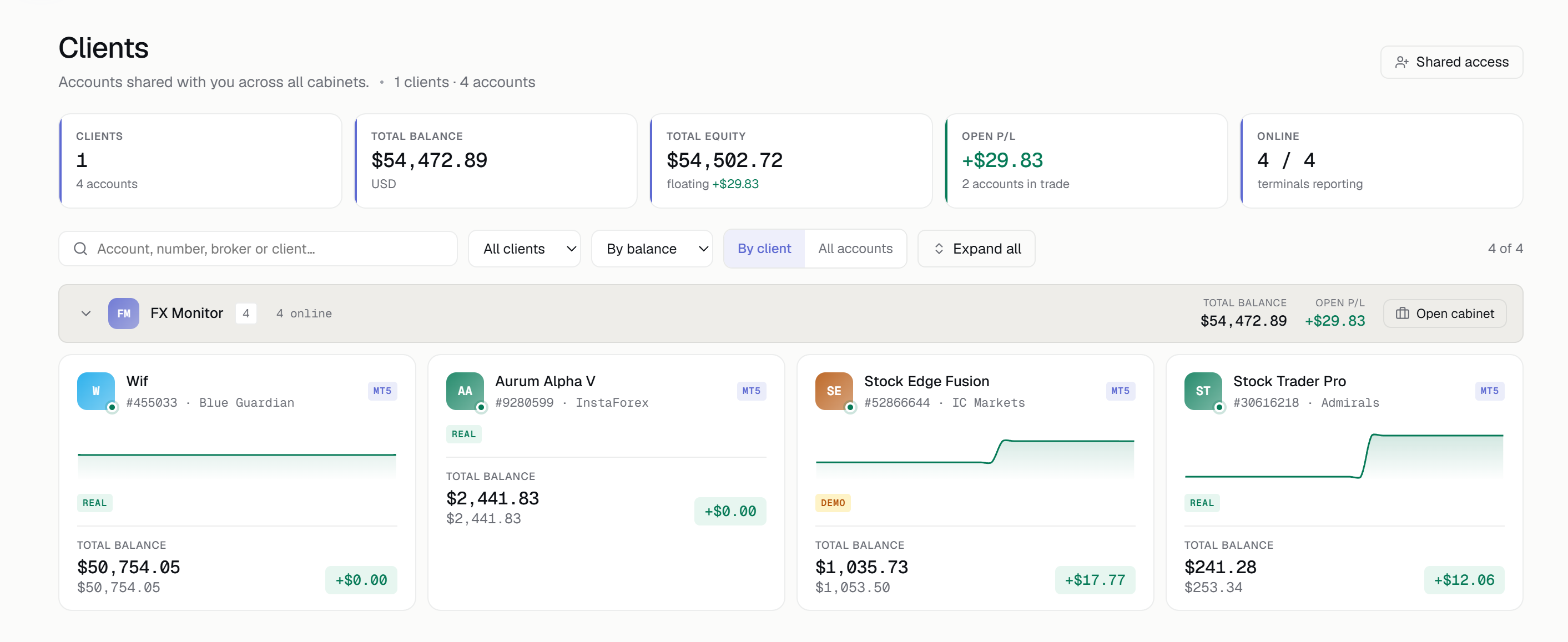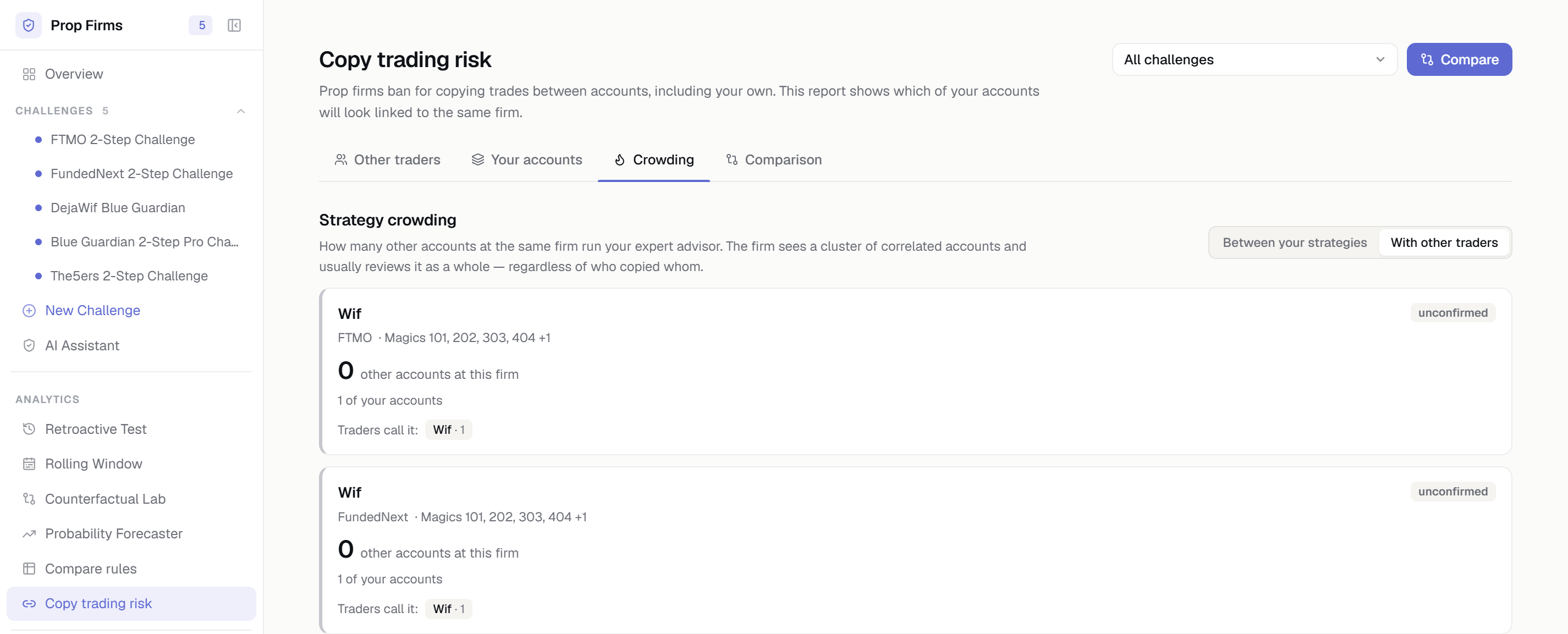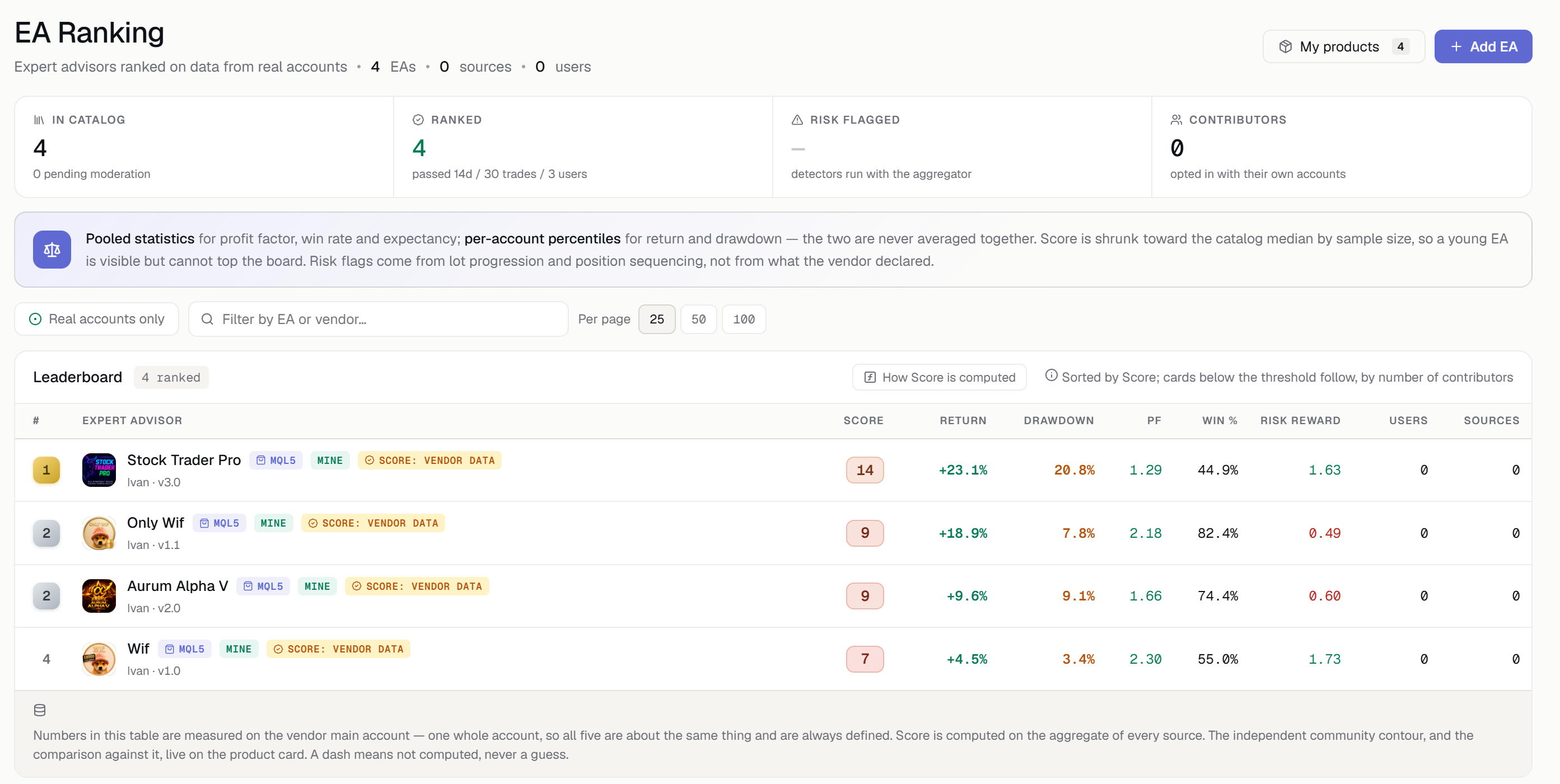
EA Ranking is now available — a ranking of Expert Advisors built on two independent sources of data at once: the author's own monitoring and the accounts of the people who bought the product.
Neither source is sufficient on its own, and that is the point. An author's monitoring is real trading, published in full, and it is the only place where the product can be seen the way its creator runs it — at his settings, on his account, with his risk. What it cannot answer is how reproducible that is: the account was selected by the author, after the result was known, and a buyer has no way of telling whether there were nine others. Buyers' accounts answer exactly that question, and nothing else — they show what the product does at other brokers, at other deposit sizes, in other hands. Put side by side, the two answer what neither answers alone.
That combination is also what makes the ranking resistant to the usual ways of inflating one. Sales figures measure how well a product was promoted, and don't enter the score at all. Reviews are text with nothing to verify them against, and there are none in the score. And cherry-picking is confined to the author's own column: the independent aggregate cannot be edited by the author — he cannot see who is in it and cannot exclude anyone from it.
Author monitoring covers the author's own accounts and backtests. Whatever he attaches becomes fully public — curve, trades, broker, server — with the login never shown and trading through the page impossible. He can attach several accounts and backtests and designate one as primary.
The independent aggregate covers the accounts of buyers who enabled participation themselves. Participation does not publish a buyer's account: only the contribution to the aggregate leaves their side, while the curve, the trades and the account number stay private, and the author never learns who took part. The aggregate isn't displayed until it contains at least three distinct people — a privacy threshold, since a smaller sample makes an individual computable. Where several EAs run on one account, what gets connected is the EA group rather than the account.
The difference between the two circuits is shown alongside them. Usually it comes down to broker conditions, lot size and entry latency rather than deception — but it is the number a buyer wants before purchasing.
Every source is verified against the author's reference and re-verified nightly: at least 80% of trades on the product's instruments, and either a 70% trade match after a random baseline is subtracted, or a 78% match on behavioural fingerprint — entry hours, holding duration, stop placement, direction distribution. Verification runs with tolerances rather than seeking exact matches, since quotes, server times and spreads differ between brokers, and a per-instrument quote correction is computed separately. Auto-revocation requires three consecutive failed days, and an absence of trades doesn't count as a failure. Demo accounts are not accepted.
All metrics are computed in R — net trade result divided by the account balance at the moment of opening — so a $500 account and a $50,000 account running the same EA are directly comparable. The score combines drawdown in R, recovery factor, expectancy, profit factor and the share of profitable sources, then applies three multipliers: sample confidence, which pulls a score toward the catalogue median the less is known about a product; a continuous age multiplier, because a product with no history simply hasn't had time to draw down; and risk flag multipliers, with a floor so flags alone cannot zero a product.
Risk flags are measured from trades rather than taken from descriptions — martingale, grid, absence of a broker-side stop, and hedging — evaluated per magic series and raised only when confirmed on at least 60% of sources. Pyramiding is displayed but not penalised. Authors can declare their mechanics in advance: the measurement runs regardless, but an honest declaration turns an undisclosed-risk flag into confirmed disclosure.
Buyers see a leaderboard, a product card with both circuits, a fan of participant results with median and percentile bands, a per-broker breakdown, a measured risk profile, a change log including moderation decisions, and a methodology page that reads its thresholds live from the system settings. Authors can dispute a specific source through moderation, and can close the independent circuit — though a closure is shown on the card and recorded in the log, and data already collected cannot be hidden.
FX Monitor takes no payment for placement in the ranking, and EAs authored by FX Monitor are excluded both from ranking and from the catalogue median. Past results do not predict future ones, no figure on the page is a forecast, the sample is survivorship-biased and is not corrected for it, and risk flags are raised by an algorithm — a flag is a flag, not a verdict.
Access is split into two plan capabilities: View EA Ranking for the section itself, and Add EA to Ranking for publishing a product. EA Ranking is available now for both MT4 and MT5.